
Quick Answer: For most gravel driveways, modified driveway stone is the better surface material because its blend of crushed stone and fines compacts into a tight, stable base that sheds water. 2B clean stone is an open, gap-graded drainage stone — it stays loose under tires and lets water drop straight through to the soil underneath, which is exactly why it belongs in drain fields and pipe bedding, not on top of a driveway. Within the modified stone category itself, a narrower gradation like 1/2-inch minus modified stone gives a more consistent, segregation-resistant finish than wider-graded 2A modified or crusher run.
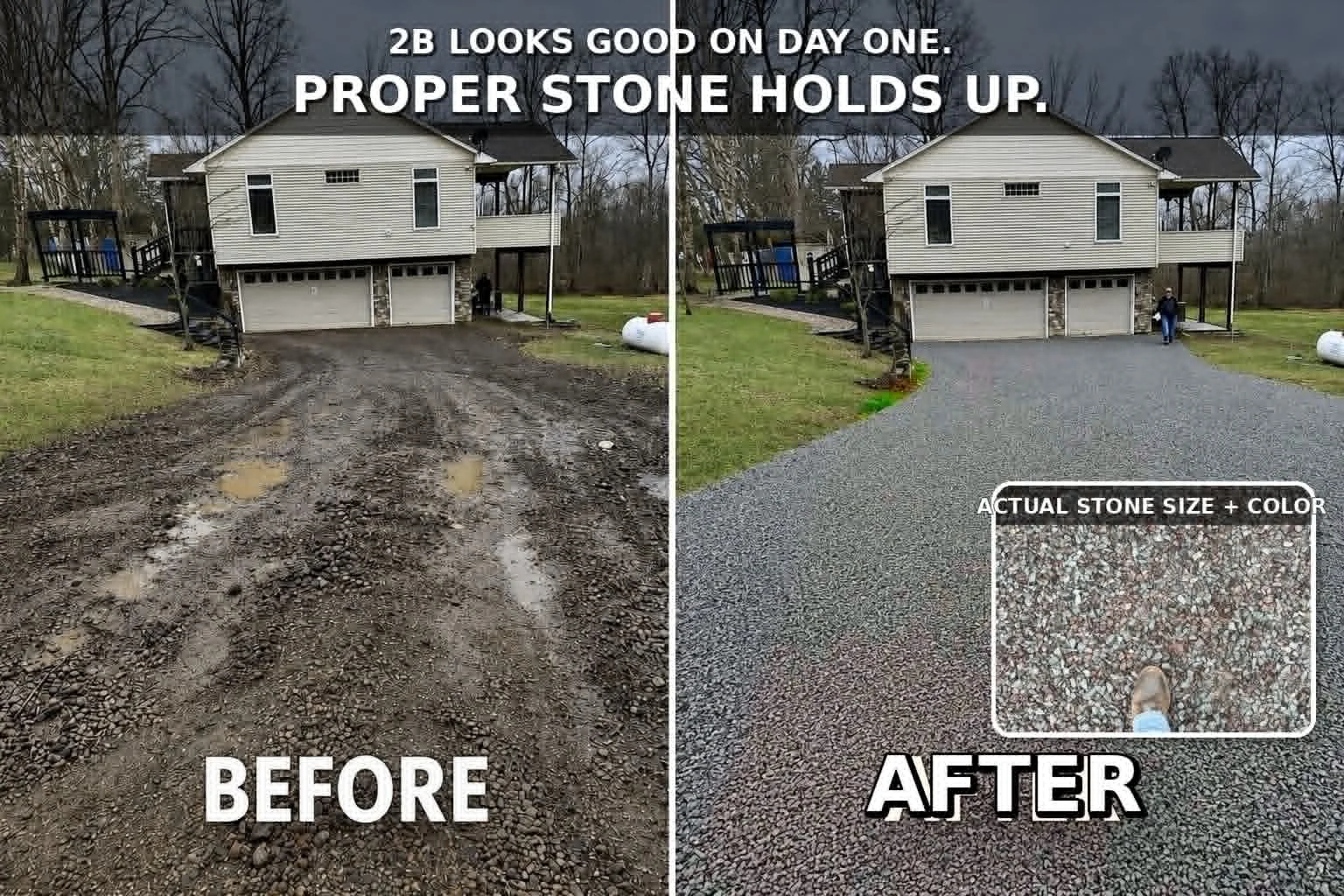
Table of Contents
Why Stone Choice Makes or Breaks a Driveway
Most homeowners hear the same line from a neighbor, a quarry counter clerk, or a quick internet search: “just use 2B stone for your driveway.” It’s repeated so often that it sounds like settled fact.
It isn’t.
2B clean stone has a job, and that job is drainage — not standing up to daily traffic, snowplows, and freeze-thaw cycles. A driveway isn’t a drain field. It needs to support vehicle weight, shed water off to the sides, hold its shape through winter, and stay tight under repeated loading. That’s a different job, and it calls for a different material: modified driveway stone.
This guide breaks down the real difference between 2B stone and modified driveway stone, why the wrong choice quietly destroys a driveway from the base up, and what an actual long-term gravel driveway system looks like.
What Is 2B Clean Stone?
2B stone is a clean, open-graded aggregate, generally crushed to around 1 to 2.5 inches, with little to no stone dust or fines mixed in. Because there’s nothing to fill the gaps between the larger pieces, the stone doesn’t lock together — it stays loose, and water moves through it freely.
That open structure is exactly why 2B stone is a go-to drainage material. It’s commonly used for:
- French drains and drainage trenches
- Bedding around perforated pipe and culverts
- Backfill behind retaining walls
- Placement under concrete slabs where drainage is needed to prevent frost heave
- Decorative gravel beds where compaction isn’t the goal
Quarries and material suppliers across Pennsylvania generally describe 2B as the stone you reach for when you need water to pass through, not when you need a surface to hold firm under a truck.
What Is Modified Driveway Stone?
Modified driveway stone (often labeled 2A modified) is a dense-graded aggregate — crushed stone mixed with smaller particles and stone dust, sized roughly 2 inches and down. Those fines aren’t filler or waste from the crushing process; they’re what allow the larger stones to interlock and compact into a firm, dense layer.
When modified stone is spread in lifts and properly compacted, it behaves less like loose gravel and more like a road base. That’s the whole point. Instead of every drop of rain disappearing straight through the surface, a well-compacted modified stone driveway helps water move across the top and off to the sides, where it belongs.
2B Stone vs. Modified Driveway Stone: Side-by-Side
| Feature | 2B Clean Stone | Modified Driveway Stone (2A) |
|---|---|---|
| Composition | Larger stone, little to no fines | Crushed stone + stone dust/fines |
| Compaction | Stays loose, does not lock together | Compacts into a dense, stable layer |
| Water behavior | Lets water pass straight through | Sheds water across the surface and off the edges |
| Best use | Drainage trenches, pipe bedding, wall backfill | Driveway base and finished surface, parking pads |
| Under traffic | Shifts, rolls, and migrates | Holds its shape under vehicles and plows |
| Plow resistance | Easily peeled up by snowplows | Resists plow damage when properly compacted |
| Long-term cost | Frequent top-ups (often yearly) | Less frequent maintenance when installed correctly |
People who read this post also read this: Gravel vs Asphalt Driveway: Cost, Lifespan, Maintenance & Long-Term Value
Why We Use 1/2″ Minus Modified Stone (Not 2A or Crusher Run)
Here’s a distinction that gets lost in most driveway advice, including the table above: not all modified stone behaves the same way, and the difference comes down to gradation — the range of particle sizes inside a single load.

Standard 2A modified and crusher run are wide-graded materials. A single truckload can contain everything from dust up to roughly 2-inch stone. That wide range is exactly what makes it prone to aggregate segregation, a well-documented issue in construction where larger stones and fine particles separate from each other during loading, hauling, and handling. The bigger the size spread in a load, the more it tends to separate — larger stones roll toward the edges and bottom of the truck bed while fines settle elsewhere, and the mix keeps separating further every time it gets dumped, pushed, or spread.
On a driveway, that shows up as an inconsistent surface: heavy, chunky stone in one stretch and mostly dust a few feet later, with no predictable pattern from one section to the next. It’s more of a cosmetic complaint than a structural failure, but it’s the single biggest reason homeowners end up unhappy with a 2A modified or crusher run driveway.
Our answer is to use a narrower-graded material — 1/2-inch minus modified stone — as the go-to surface for most of our driveway work. Because the particle sizes sit much closer together, it resists the segregation that wider-graded stone runs into during the truck ride and every handling step afterward. The result is a consistent look from one end of the driveway to the other, not just at the pile.
There’s a bonus that shows up after the first real rain: the fines settle in slightly, and the surface finishes out with a clean, pea-gravel-like appearance on top while staying locked tight just underneath. Paired with geotextile separation fabric, 1/2-inch minus modified stone gives us a system that solves most of the recurring problems we used to see with wider-graded 2A modified and crusher run — which is exactly why we’ve moved away from leaning on those products as the primary surface stone.
| Factor | 2A Modified / Crusher Run | 1/2″ Minus Modified Stone |
|---|---|---|
| Particle size range | Wide — dust up to roughly 2″ in the same load | Narrow — dust up to 1/2″ |
| Segregation risk in transport/handling | Higher — coarse stone and fines separate out | Lower — narrow range resists separation |
| Surface consistency | Can vary noticeably section to section | Consistent end to end |
| Finished appearance | Mixed stone sizes, dusty or chunky patches | Settles to a clean, uniform pea-gravel look after the first rain |
| Compaction | Compacts well | Compacts well and locks tight just below the surface |
If there’s one thing to take from this guide, it’s that the words “modified stone” on an invoice don’t tell the whole story. Gradation matters as much as the label. Ask what the particle size range is, ask about the fines content, and ask how consistent the look has been on past jobs — not just whether it’s called “modified.”

A Gravel Driveway Should Not Behave Like a Drain
This is where most driveway problems start. People assume that because a stone drains well, it must be good for a driveway. That logic sounds reasonable for about five seconds — which is usually how long bad construction advice survives before it costs someone money.
Water moving through your driveway surface and down into the soil underneath isn’t a feature; it’s a failure mode. Once that base soil gets saturated, it softens, and a soft base can’t support anything on top of it. From there, the usual list shows up fast:
- Potholes and low spots
- Deep ruts from tires and plow blades
- Mud pumping up through the stone
- Stone disappearing into the ground
- Surface gravel peeled away by the plow
- Needing a fresh load of stone every year or two
At that point, the driveway isn’t failing because of bad luck or a heavy plow truck. It’s failing because the system underneath was built to let water attack the base, one rainstorm at a time.
Why Rural and Wooded NEPA Driveways Are Especially at Risk
A lot of driveways across Northeastern Pennsylvania run through old fields, wooded lots, and former farm ground. That land was often cleared generations ago, with the rocks pulled out of the soil and stacked into the stone walls still lining the property edges today.
When a home eventually gets built on that ground, the driveway contractor starts at the road and hauls load after load — sometimes hundreds of tons — back into that same field. If the base is built from large stone, then smaller stone, then finished with clean 2B on top, it can look great for the first season. Clean lines, even color, a fresh surface.
But if the whole system stays open from top to bottom, every rainstorm sends water straight through the stone until it hits the native soil. And soil that collects water doesn’t stay solid — it turns soft, and now you’re driving across a stone-covered mud hole without even knowing it. From the surface, the stone looks fine. Underneath, the base can be getting weaker with every storm.
The Real Job of a Driveway’s Top Layer
The finished surface of a gravel driveway isn’t there just to look clean. It has actual work to do. A properly built driveway top layer needs to:
- Lock together under compaction
- Support the weight of vehicles and equipment
- Hold a crown or pitch (typically a slope of around 2%, or roughly a quarter-inch per foot)
- Shed water off to the sides instead of letting it pool
- Resist damage from snowplow blades
- Protect the base material underneath
- Reduce rutting and pothole formation over time
2B clean stone struggles with almost every item on that list, because it was never engineered to bind. It stays loose, rolls under tires, and gets pushed around by traffic and plowing. Modified driveway stone, installed and compacted correctly, is built to do exactly this job.
Where 2B Stone Still Belongs
None of this means 2B stone is a bad product — it just means it’s frequently used for the wrong job. 2B clean stone is genuinely useful for:
- French drains and drainage trenches
- Bedding around perforated pipe
- Culvert bedding in certain applications
- Backfill behind retaining walls
- Placement under concrete where drainage is the goal
- Decorative areas where compaction isn’t required
It’s a drainage material, full stop. That’s exactly why it isn’t the right choice as the main finished surface on most gravel driveways — a driveway should control water, not invite it down into the base.
The Overlooked Layer: Geotextile Fabric
Even the right stone can fail if it’s placed directly over weak or saturated soil. That’s where geotextile separation fabric earns its place in a driveway system.
A driveway-grade geotextile fabric is a permeable woven or non-woven sheet that lets water pass through while physically blocking soil particles from migrating upward. Without it, fine soil can slowly work its way up into the stone base under repeated traffic — engineers sometimes call this “fines intrusion” or “pumping” — while the stone itself can sink down into soft ground. Over time, that contaminated base loses its drainage capacity, gets progressively softer, and settles unevenly, which is exactly when potholes and soft spots start appearing seemingly out of nowhere.
In plain terms: the fabric keeps the stone doing the stone’s job, and keeps the dirt where the dirt belongs. That separation matters most on wet ground, old farm fields, wooded lots, clay-heavy soil, and any driveway that already has a history of rutting or potholes.
Building the Right Gravel Driveway System
A driveway that actually holds up is a system, not a single material. A properly built gravel driveway generally includes:
- Proper grading — the driveway needs the right shape and a 2-5% crown or cross-slope before stone goes down.
- Soil separation fabric where needed — fabric stops the stone from disappearing into soft soil over time.
- A stable base — soft or low areas may need larger stone or full base correction before the surface layer is added.
- A narrow-graded modified stone as the surface — we favor 1/2-inch minus modified stone specifically, compacted in lifts so it locks tight, resists segregation, and holds a consistent look.
- Crown or pitch — water needs a clear path off the driveway, not a flat or inverted surface that lets it pool.
- Drainage correction — if water is running across the driveway from uphill, that has to be addressed separately, often with swales or culverts.
Stone alone doesn’t fix a water problem; it just hides it for a season or two. Dumping fresh stone on a driveway with no grading, no fabric, and no drainage plan isn’t a repair — it’s a subscription plan for failure.

Why Your Driveway Keeps Losing Stone
If a driveway needs fresh stone every year or two, “normal wear” usually isn’t the real explanation. More often, the cause is one or more of the following:
- The wrong stone on the surface (2B instead of modified)
- No crown, so water sits instead of running off
- No drainage correction for uphill runoff
- No soil separation fabric under the base
- Water passing straight through the surface into the soil
- Soft, saturated soil underneath the stone
- Loose stone rolling and migrating under traffic
- Plow damage caused by an unstable, loose surface
A correctly built gravel driveway should need routine maintenance — not a full rebuild of the same failure, year after year.
Final Take: Stop Building Driveways Like Drainage Beds
2B clean stone has a purpose, and it’s a good one — just not as the main finished surface on most gravel driveways. If the goal is drainage, 2B makes sense. If the goal is a driveway that holds together, sheds water, supports vehicles, handles snowplowing, and doesn’t need constant rebuilding, modified driveway stone is almost always the better answer.
A lot of driveways have been built the wrong way for a long time, often on well-meaning advice that never accounted for what’s happening underneath the surface. The good news is that most of them can be fixed. With proper grading, drainage correction, geotextile fabric, and a correctly compacted layer of modified driveway stone, a failing gravel driveway can be turned into a stronger, cleaner, longer-lasting surface — because water runs downhill every time, and the driveway just needs to be built smart enough to get out of its way.
Frequently Asked Questions
What is the difference between 2B stone and modified driveway stone?
2B stone is a clean, open aggregate with little to no fines, so it drains well but doesn’t compact. Modified driveway stone contains crushed stone plus stone dust and fines, which fill the gaps between particles and let it compact into a dense, stable surface — the reason it performs better as a driveway top layer.
Can I use 2B stone for a driveway?
2B stone can be used in a driveway’s drainage components, such as behind culverts or in subsurface drains, but it’s generally a poor choice as the finished surface. Because it has no fines to bind it, 2B tends to stay loose, roll under tires, and let water pass straight through to the soil below.
Why does my gravel driveway keep getting potholes and ruts?
Recurring potholes usually trace back to water reaching the soil beneath the stone. Common causes include the wrong surface material (often 2B instead of modified stone), a flat or damaged crown, missing geotextile fabric, and uncorrected runoff from higher ground.
Do I need geotextile fabric under a gravel driveway?
Geotextile fabric is recommended for most gravel driveways, especially on wet ground, clay soil, old farm fields, or driveways with a history of rutting. It separates the stone base from the native soil, which prevents the stone from sinking and stops soil from migrating up into the base over time.
How thick should a modified stone driveway base be?
Driveway base thickness varies with soil conditions and expected traffic, but residential gravel driveways commonly use roughly 8 to 12 inches of compacted modified stone, often built up in multiple compacted lifts rather than dumped in a single layer.
How often should a gravel driveway be re-stoned?
A properly built driveway with the right stone, crown, drainage, and fabric should only need light surface maintenance every few years — not a full reload of fresh stone every season. Needing new stone annually is usually a sign of an underlying base or drainage problem, not normal wear.
Is crusher run the same thing as modified driveway stone?
Crusher run and 2A modified stone are closely related — both are wide, dense-graded aggregates that combine crushed stone with fines to compact into a firm base. Because the particle sizes in a single load range so widely, both are also prone to aggregate segregation during hauling and handling, which is why some installers prefer a narrower gradation, such as 1/2-inch minus modified stone, for the finished surface.
What is 1/2 inch minus modified stone?
1/2-inch minus modified stone is a crushed stone product screened to 1/2 inch and smaller, with fines included. Its narrow particle size range resists segregation during hauling and spreading far better than wider-graded materials like 2A modified or crusher run, while still compacting into a tight, stable surface — which is why it’s often used as a go-to finished driveway surface rather than just a base.
Why does my gravel driveway look inconsistent, with big rocks in some spots and dust or fines in others?
That’s typically aggregate segregation, a common issue with wide-graded materials such as 2A modified or crusher run. Because a single load can contain particle sizes from dust up to roughly 2 inches, the larger stones and fine particles separate during loading, the truck ride, and spreading, leaving an uneven look. Narrower-graded materials, like 1/2-inch minus modified stone, are far less prone to this since there’s less size difference between the largest and smallest particles in the mix.
Do I still need geotextile fabric if I use 1/2 inch minus modified stone?
Yes. Fabric and stone solve two different problems: the fabric keeps the stone separated from the soil underneath, while the stone itself handles compaction and surface performance. Pairing geotextile fabric with 1/2-inch minus modified stone is what allows that combination to perform as both a stable base and a finished, consistent-looking surface in one step.
Does “2A modified” mean the same thing everywhere?
Not always. Stone classifications and naming conventions can vary by state, region, and even individual quarry, so the same name doesn’t guarantee the same gradation everywhere. When in doubt, ask your local supplier or contractor to describe the fines content and intended use rather than relying on the label alone.

