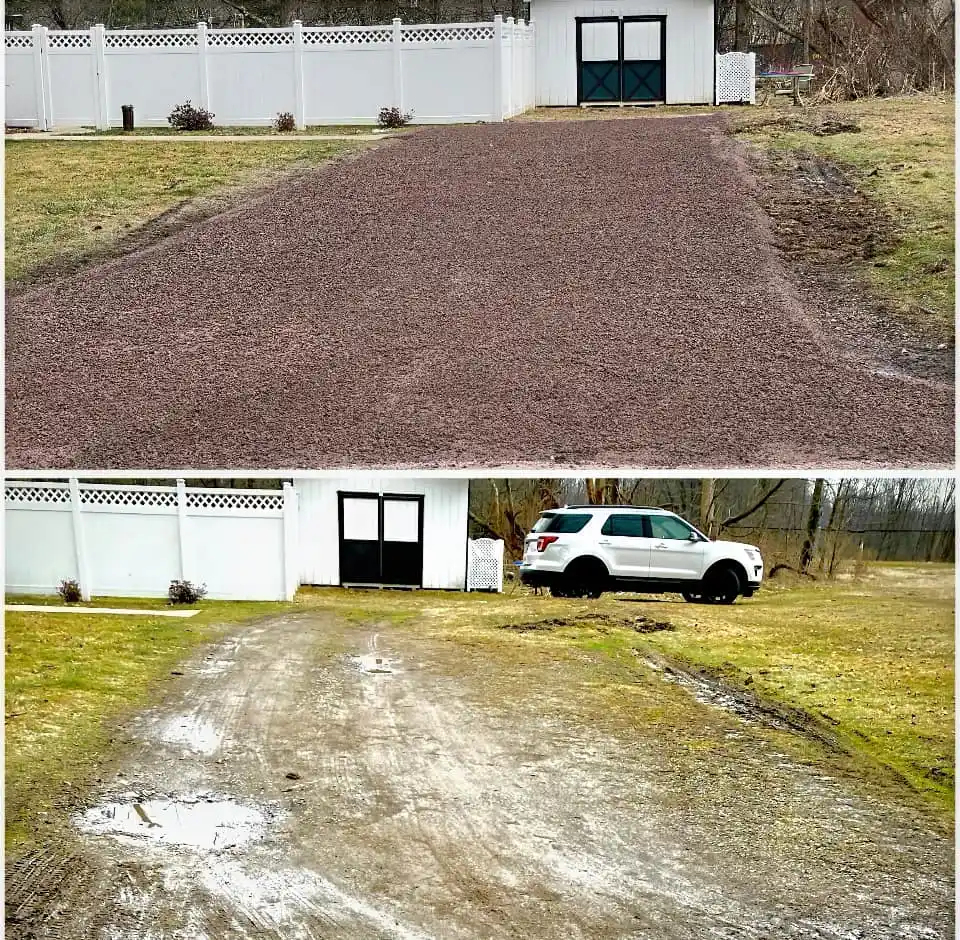
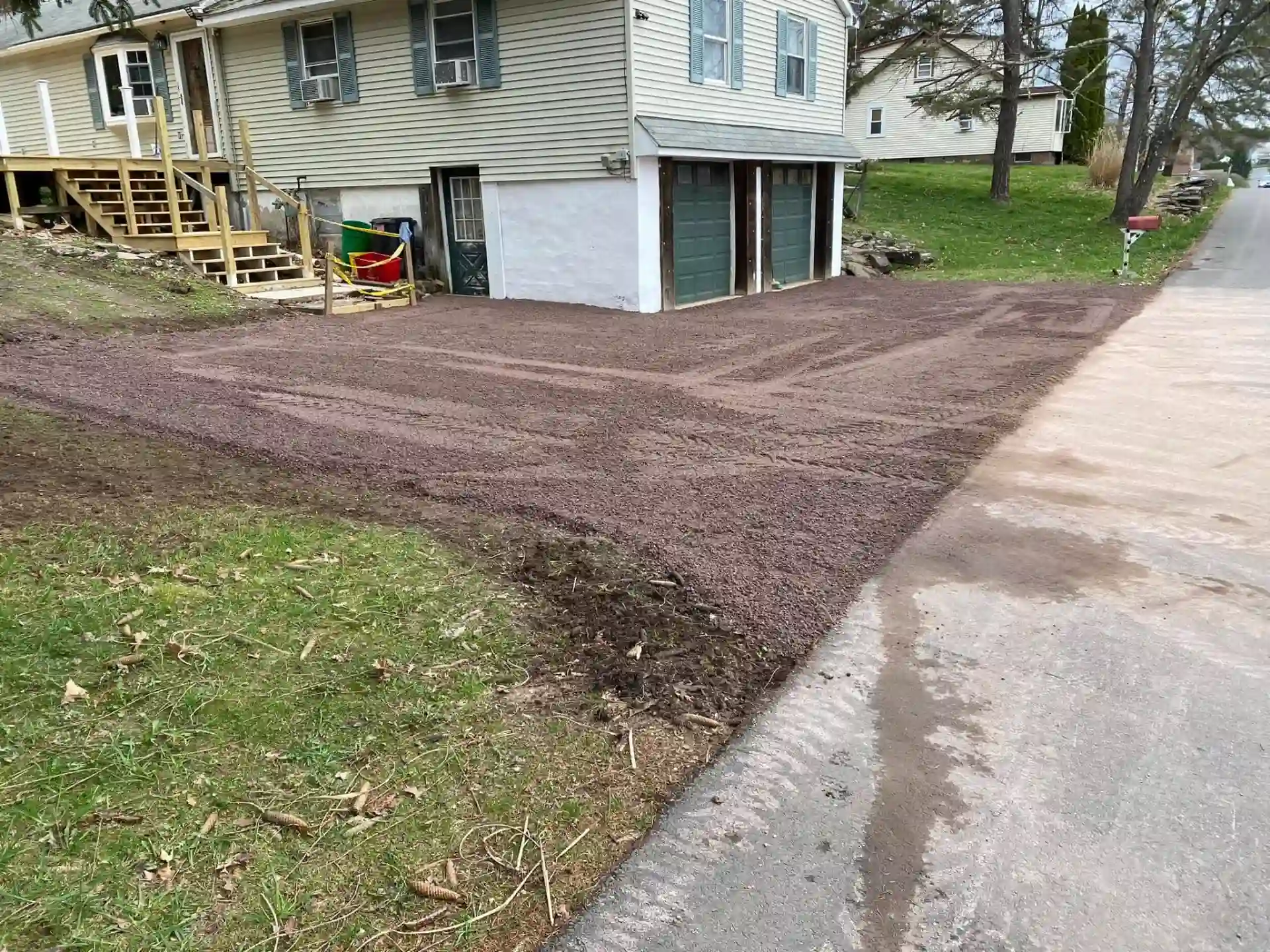
Driveway Washout and Storm Damage Repair in Northeastern Pennsylvania
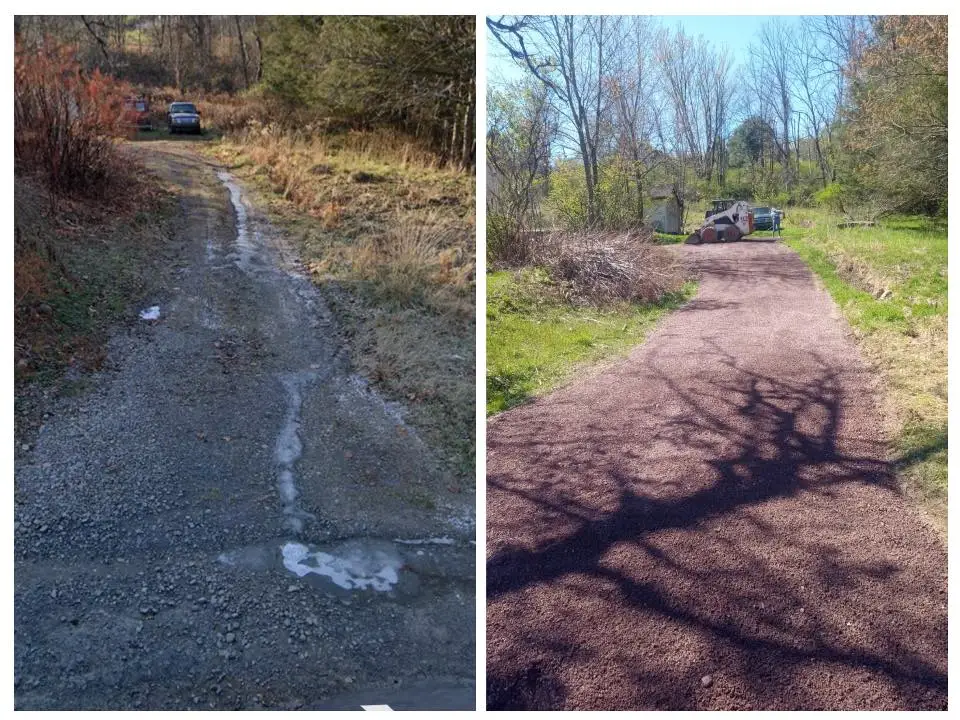
One hard rain can carry stone downhill, open deep channels, expose the base, collapse edges, and make a driveway unsafe to use.
Alliance Excavating & Stone Works repairs storm-damaged driveways throughout Northeastern Pennsylvania by finding where the runoff came from, rebuilding what failed underneath, and correcting the water path before replacing the missing stone.
Call 570-690-6297 for an honest on-site evaluation.


Get a Free Estimate
Whether you need affordable driveway repair near you, a drainage solution, or a full gravel driveway installation, we’re ready to help.
Direct Answer: How Do You Fix a Washed-Out Driveway?
A washed-out driveway is repaired by removing unstable material, rebuilding the damaged base, correcting the grade, controlling the runoff, and installing properly compacted driveway stone. Replacing the missing gravel without fixing the water problem usually leads to another washout.
We repair storm damage, rebuild failed areas, replace washed-away gravel, correct drainage problems, and restore damaged driveways so the same runoff is less likely to tear them apart again.
We do not just push stone into the hole and call it fixed.
We start by figuring out where the water came from, what failed underneath the surface, and what needs to change before the driveway is rebuilt.

Signs Your Driveway Has Storm or Washout Damage
A washout does not always mean the whole driveway disappeared.
Sometimes it starts as a small channel along one tire track. Sometimes stone collects at the bottom of a hill. In other cases, water cuts under the driveway edge or washes the material away from a culvert.
These smaller warning signs show where the water wants to travel.
| What You See | What It May Mean |
|---|---|
| Gravel collecting at the bottom of the driveway | Runoff is carrying the surface material downhill |
| Long channels or deep ruts | Water has established a path along the driveway |
| Large base stone showing through | Surface material and fine particles have washed away |
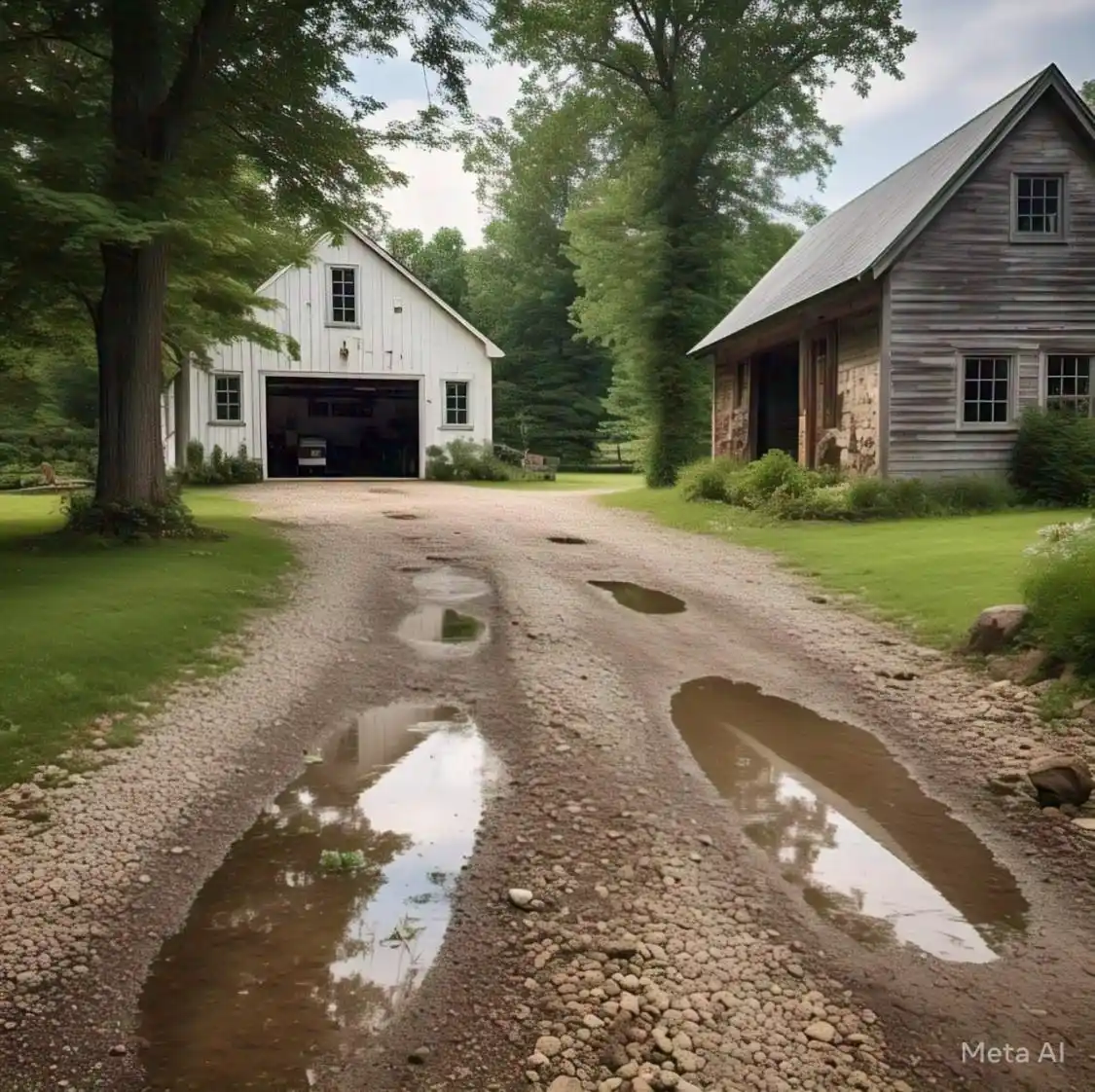
| Soft or muddy areas | The base or subgrade may be saturated |
| A crumbling outside edge | Water may have removed the support under the shoulder |
| Water crossing the driveway | A ditch, swale, or culvert may not be handling the runoff |
| Erosion around a culvert pipe | Water may be bypassing the pipe or scouring the inlet or outlet |
| Repeated repairs washing away | The drainage problem was never permanently corrected |
Other signs include:
- Mud and sediment washing onto the public road
- Loose stone moving every time it rains
- Water flowing down the tire paths
- A driveway entrance beginning to settle
- Hollow or unsupported areas near the edge
- A culvert filled with leaves, branches, mud, or stone
- A sudden drop-off beside the driving surface
- Vehicle access becoming difficult after a storm
A narrow channel can become a major failure once water reaches the base underneath. The sooner the cause is identified, the better chance there is of repairing one section before the damage spreads.
Why Driveways Wash Out During Heavy Rain
Water takes the easiest path it can find.
When a driveway has lost its crown, settled unevenly, or developed low spots, rainwater can begin traveling along the driving surface instead of shedding toward the sides. Once that water gains speed, it starts carrying loose gravel and fine material with it.
That is how many washouts begin.
Other washouts are caused by water entering from outside the driveway. Runoff may be coming from:
- A wooded hillside
- A neighboring property
- A roadside ditch
- An overflowing culvert
- A downspout
- A lawn or field
- A higher section of the driveway
- Water collecting near the garage or house
Common causes of driveway washouts include:
- A worn-down or incorrectly shaped crown
- Poor surface grading
- Concentrated hillside runoff
- Blocked drainage ditches
- Damaged or undersized culverts
- Loose stone that was never properly compacted
- Weak or saturated subgrade
- Missing geotextile separation fabric
- Failed drainage outlets
- Water discharging directly onto the driveway
- Freeze-and-thaw movement creating low areas
- Driveway edges that no longer have proper support
The visible channel is often only the result.
The actual problem may be farther uphill, underneath the driveway, or around a drainage pipe. That is why proper driveway washout repair starts with tracing the water instead of immediately ordering another load of stone.
Missing Gravel and Exposed Driveway Base
When surface stone washes away, the material underneath becomes exposed.
Sometimes the remaining base is still firm and can be reshaped. Other times, moving water has carried away the fine material that held the driveway together. The remaining stone may look solid but feel loose, hollow, soft, or unstable when driven over.
We inspect the damaged area to determine:
- How much stone was lost
- Whether the existing base is still stable
- How deeply the water cut into the driveway
- Whether water moved over or through the base
- Whether unsuitable soil needs to be removed
- Whether geotextile fabric is needed
- Whether the repair can be limited to one section
- Whether the failed area needs to be excavated and rebuilt
We are not going to tell you the whole driveway needs rebuilt when one properly repaired section will solve the problem.
But we are also not going to cover a soft, washed-out base with fresh gravel and pretend that it is permanently fixed.
Deep Channels, Ruts, and Surface Erosion
Deep channels mean water has established a regular path.
If that path is not changed, the water will normally return to the same place during the next storm. Filling the trench without correcting the grade puts the new material right back into the runoff channel.
Depending on the condition of the driveway, repairs may include:
- Cutting out loose and unstable material
- Excavating damaged sections
- Rebuilding the stone base
- Filling and compacting deep channels
- Reshaping the driving surface
- Restoring the driveway crown
- Creating a controlled cross slope
- Redirecting runoff toward a ditch or swale
- Installing modified driveway stone
- Mechanically compacting the finished surface
The goal is not only to replace what washed away.
The goal is to change how the water moves so it does not keep cutting through the same area.
Failed Driveway Edges and Washed-Out Shoulders
Driveway edges can fail quickly during heavy rain.
Water running alongside the driveway may scour away the shoulder and remove the support underneath the driving surface. Once that support is gone, the outside edge can crumble, settle, or collapse under the weight of a vehicle.
This is especially common around:
- Steep driveways
- Narrow entrances
- Drop-offs
- Culvert crossings
- Roadside ditches
- Low shoulders
- Sharp turns
- Areas where runoff leaves the driveway
A failed edge may need more than loose fill pushed back into place.
The unstable material may need to be removed. The shoulder may need to be rebuilt in compacted layers, and the water may need a protected place to leave the property without cutting the edge apart again.
The exact repair depends on how far the damage extends beneath the visible surface.
Blocked Culverts and Erosion Around Culvert Pipes
A driveway culvert is supposed to carry water underneath the entrance.
When the inlet becomes blocked with leaves, mud, branches, gravel, or sediment, the water begins backing up. Once it reaches the top of the ditch, it may cross over the driveway or start cutting around the outside of the pipe.
That can cause:
- Missing stone around the driveway entrance
- Erosion beside or underneath the pipe
- A collapsed driveway edge
- Settlement above the culvert
- Water bypassing the culvert
- Damage around the inlet or outlet
- Soil washing into the ditch
- Unsafe vehicle access
We inspect both ends of the culvert, along with the driveway above it.
A permanent correction may involve:
- Clearing the drainage path
- Reopening the roadside ditch
- Removing built-up sediment
- Repairing the culvert inlet
- Stabilizing the outlet
- Rebuilding eroded material around the pipe
- Replacing a crushed, collapsed, or unsuitable culvert
- Adding stone or erosion protection at the discharge point
Some culvert projects require utility marking, township approval, engineering, or additional permits. We will explain when a project goes beyond a straightforward excavation and repair.
Emergency Driveway Stabilization
Some storm damage needs immediate attention, even when the full repair cannot be completed right away.
The ground may still be saturated. Water may still be moving through the site. A replacement pipe may need to be ordered, or the damaged area may need to dry before it can be properly rebuilt.
When conditions and scheduling allow, emergency stabilization may include:
- Filling dangerous holes or channels
- Restoring temporary vehicle access
- Stabilizing a failed driveway edge
- Placing temporary stone
- Redirecting active runoff
- Clearing debris from a ditch or culvert
- Protecting an exposed base from additional damage
Temporary stabilization is not the same as permanent correction.
We will tell you what can be done immediately, what still needs to be repaired, and whether the damaged section should be avoided until the work is complete.
How Driveway Washout Repair Works
Every property is different, but our process starts with the cause of the failure instead of simply pushing stone into the hole.
1. Inspect the Damage
We inspect the washed-out section, the grade, the remaining base, the shoulders, nearby drainage structures, and the surrounding property.
2. Find the Source of the Water
Runoff may be coming from the driveway itself, a hillside, a ditch, a culvert, a downspout, the public road, or another part of the property.
3. Remove Failed Material
Loose gravel, mud, saturated soil, and unstable base material may need to be excavated before new material is installed.
4. Stabilize the Subgrade
Soft ground may need to be undercut, reshaped, dried, or reinforced with geotextile fabric.
5. Rebuild the Base
Severely damaged sections may need larger aggregate or base stone installed and compacted in layers.
6. Correct the Grade and Drainage
The driveway is reshaped so water has a controlled way to leave the surface. That may mean restoring a crown, creating a cross slope, reopening a ditch, clearing a culvert, reshaping a swale, or stabilizing an outlet.
7. Install and Compact Surface Stone
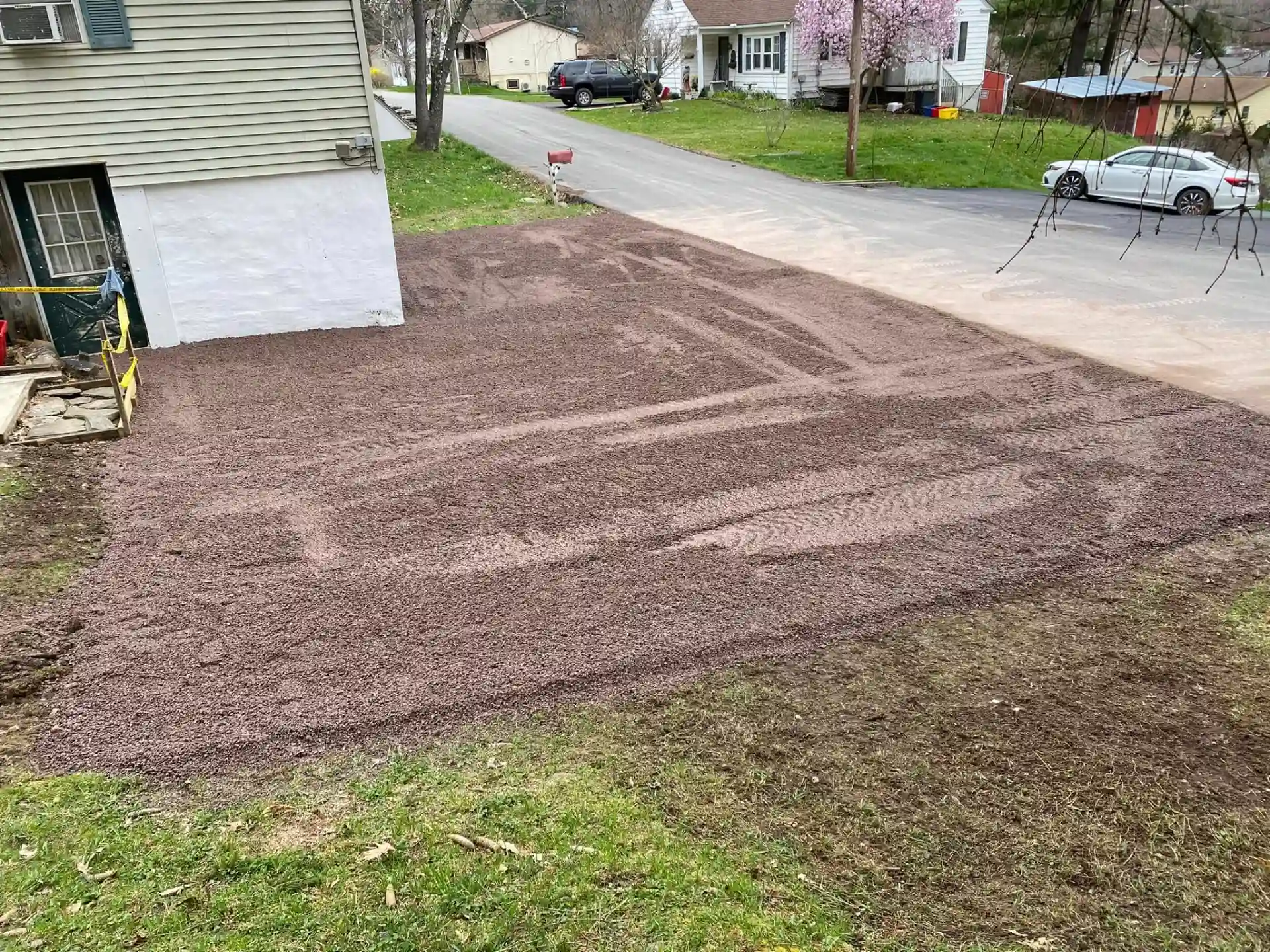
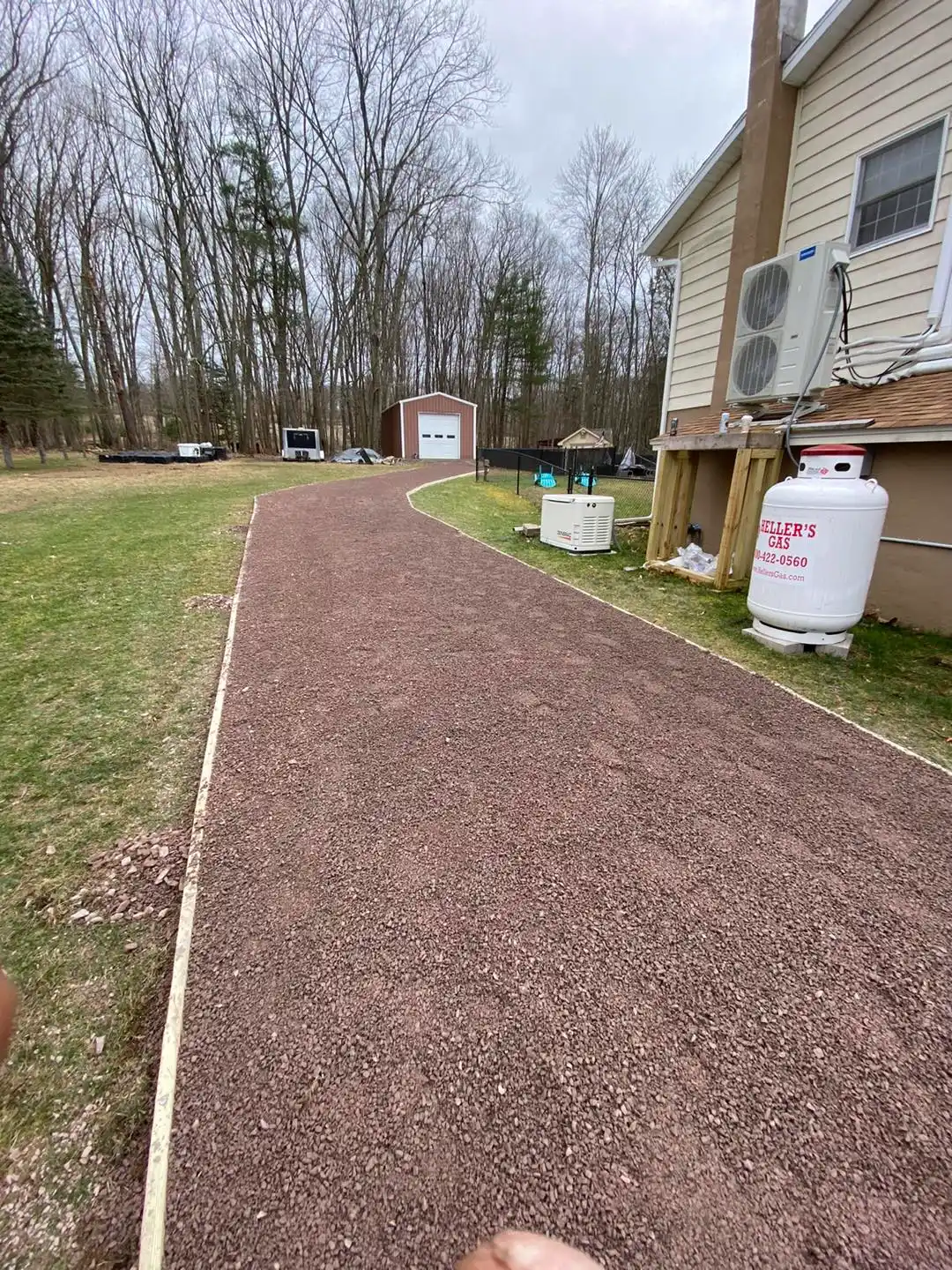
Once the base and drainage are corrected, we install compactable driveway stone and shape the finished surface.
Why Adding More Gravel Usually Does Not Fix a Washout
Fresh gravel may replace what washed away, but it does not change where the stormwater goes. If water is still flowing down the tire paths, crossing the entrance, or cutting around a culvert, the new stone can disappear during the next hard rain.
Proper driveway washout repair starts by tracing the runoff and checking whether the base is still stable.
Drainage-First Repair
Not every washout needs a French drain, and not every driveway needs a new culvert. The correct solution depends on whether the water is flowing across the surface, through the base, out of a hillside, or from a concentrated drainage source.
Can We Repair One Section Without Rebuilding the Whole Driveway?
Sometimes we can. A localized repair may be practical when the surrounding driveway is stable and the runoff problem can be corrected without rebuilding everything.
| A Localized Repair May Work When | A Larger Rebuild May Be Needed When |
|---|---|
| The damage is limited to one section | Several sections are failing |
| The surrounding base remains firm | The driveway has little or no stable base |
| The water source can be redirected | Water is moving through the entire driveway |
| One edge or shoulder failed | Both edges are collapsing |
| The culvert remains structurally sound | The culvert has failed underneath the entrance |
Storm Damage in Northeastern Pennsylvania
Driveways in Northeastern Pennsylvania deal with a rough combination of conditions.
Around Sweet Valley, Hunlock Creek, Shickshinny, Harveys Lake, Dallas, and the Back Mountain, we regularly see:
- Steep rural driveways
- Wooded hillsides
- Roadside drainage ditches
- Clay and wet subsoil
- Water coming off mountains and fields
- Long driveways collecting runoff from large areas
- Freeze-and-thaw damage
- Sudden summer downpours
- Spring ground saturation
- Lakefront and low-lying properties
A driveway may hold up during a normal rain and then get torn apart during one slow-moving storm.
That is why we look at more than how the driveway appears on a dry afternoon. The repair has to account for where the water goes when the soil is saturated and the rain is coming down hard.
What You Can Expect From Alliance
- Honest on-site evaluation
- Drainage-first troubleshooting
- Excavation of failed material
- Geotextile fabric where needed
- Base rebuilding and driveway regrading
- Modified stone installation
- Mechanical compaction
- Culvert and ditch correction
- Emergency stabilization when available
- Clear written scope of work
- Five-year workmanship guarantee
We do not just drop stone. We find out why the driveway failed, rebuild the damaged area, and give the water a better place to go.

Driveway Washout Repair Service Areas
Alliance provides storm damage and washout repairs throughout Northeastern Pennsylvania, including Sweet Valley, Hunlock Creek, Shickshinny, Dallas, Shavertown, Trucksville, Lehman, Harveys Lake, Huntington Mills, Benton, Mountain Top, Bear Creek, and nearby Back Mountain communities.
- Sweet Valley
- Hunlock Creek
- Shickshinny
- Dallas
- Shavertown
- Trucksville
- Lehman
- Harveys Lake
- Huntington Mills
- Benton
- Mountain Top
- Bear Creek
Related Services
Testimonials
EXCELLENT Based on 15 reviews
 Posted on Google
 Ann KesslerThe work done by Alliance was excellent. The job was extensive. We had a wet basement that could not be water proofed from the inside. John Deyo worked with the township to devise a plan to redirect the water away from my home. The project was completed in a timely manner and my drainage problem was solved. I also had a new gravel driveway done. It too was done exceptionally well. I was very impressed with the planning, the installation, and the professionalism. I would highly recommend Alliance to anyone.Posted on Google
 Marvin ReemI had Alliance re-gravel my driveway and also put new drainage around the garage entrance. They have a good eye for detail and definitely exceeded my expectations.Posted on Google
 Rick ClemowAlliance did a fantastic job on my driveway, had to cut out a giant rock , laid modified and came out beautiful. Would highly reccomend.Posted on Google
 Timothy Ide“Second time using Alliance Excavating & Stone Works here in Shavertown, PA. I came back because the first job held up exactly like they said it would. This time my driveway had standing water and constant mud issues. I took before and after photos and videos—the difference is unreal. They didn’t just add stone, they fixed the grading and drainage so the water actually moves off the driveway. No more mud, no more puddles. Solid work that lasts. If your driveway keeps failing, call them.”Posted on Google
 Sherry PetroskiWe had constant issues with water running across our driveway and washing the stone out. It would turn into mud every time it rained. Alliance Excavating & Stone Works came in, fixed the drainage, regraded everything, and rebuilt the base the right way. Huge difference. No more washouts and the driveway finally holds up. Highly recommend.
Send us a message

Common Questions
Frequently Asked Questions About Driveway Washout Repair
A driveway normally keeps washing out because water is traveling along or across the driving surface instead of leaving in a controlled direction. Common causes include poor grading, a lost crown, uphill runoff, blocked culverts, failed ditches, and weak base material.
Not when the base or drainage has failed. Fresh gravel may replace the missing surface temporarily, but it can wash away again when water follows the same path. The source of the runoff and condition of the base should be checked first.
The driveway may need to be regraded, crowned, or sloped so water sheds toward a controlled drainage area. Ditches, swales, culverts, catch basins, or drainage pipe may also be needed depending on where the runoff originates.
Yes, when the damage is localized and the surrounding driveway still has a stable base. A larger rebuild may be necessary when several sections are failing or water has damaged the subgrade throughout the driveway.
Avoid driving across areas that are deeply eroded, soft, hollow, or unsupported along the edge. Take pictures of the damage and where the water traveled, then contact an experienced excavation or driveway contractor before another storm causes more damage.
Yes, depending on the condition of the pipe and surrounding area. The work may involve clearing the inlet, rebuilding support, correcting the ditch, stabilizing the outlet, or replacing a damaged culvert.
Emergency stabilization may be available depending on scheduling, weather, access, and the severity of the damage. Temporary work may restore access or prevent additional damage, but a permanent correction may still be required.
The cost depends on the size and depth of the damaged area, the base condition, equipment access, required stone, drainage work, and culvert condition. Alliance inspects the property before recommending a repair scope and price.
Coverage depends on the policy and the cause of the damage. Contact your insurance provider and request a written coverage decision. Alliance can provide a written repair proposal, but cannot determine whether your claim is covered.
Severe washouts should normally be evaluated by an excavation, grading, drainage, or driveway contractor with the equipment to remove unstable material, rebuild the base, and correct the water problem.