
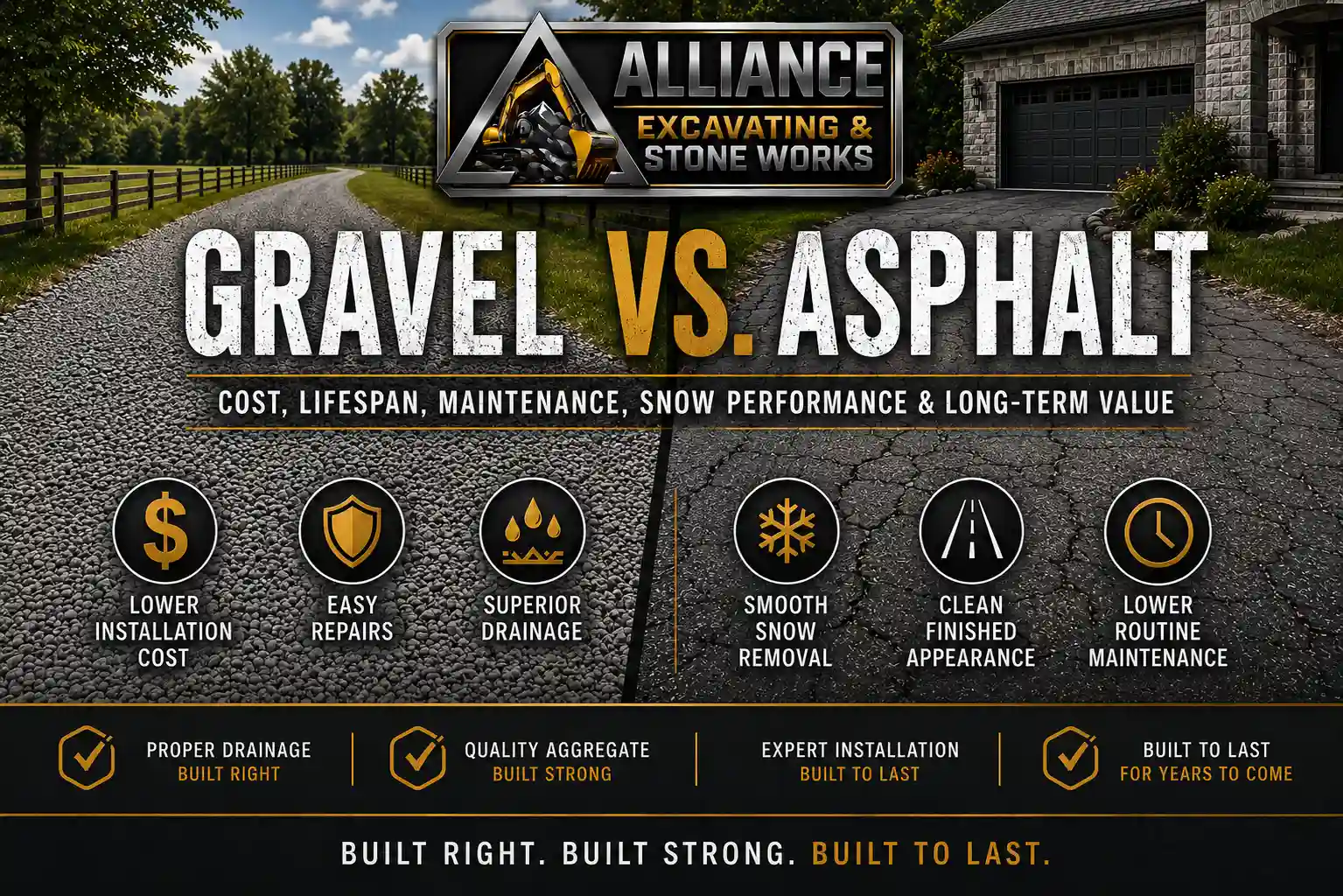
Choosing between a gravel vs asphalt driveway is one of the most important decisions homeowners make when improving their property. At first glance the choice seems simple. Gravel is usually less expensive while asphalt offers a smoother and more finished appearance.
However, installation cost is only one piece of the puzzle.
The real questions are:
- Which driveway will hold up longer?
- Which driveway costs less to own over time?
- Which performs better during snow and freeze-thaw cycles?
- Which handles drainage more effectively?
- Which requires less maintenance?
- Which provides the best value for your specific property?
Most articles compare gravel and asphalt as if the surface material alone determines performance. In reality, drainage, soil conditions, base construction, traffic volume, and maintenance habits often have a much greater impact on driveway life than the material you see on top.
In this guide, we’ll compare gravel vs asphalt driveway cost, lifespan, maintenance requirements, snow performance, drainage characteristics, and long-term ownership costs so you can make a more informed decision.
Quick Answer: Gravel vs Asphalt Driveway
If your primary concern is affordability and long-term repair flexibility, a gravel driveway is often the better investment. If you prioritize curb appeal, a smooth surface, and easier snow removal, asphalt may make more sense.
The truth is that both materials can perform exceptionally well when installed correctly. In our experience at Alliance Excavating & Stone Works, most driveway failures are caused by water, poor drainage, weak bases, and inadequate construction—not by the choice between gravel and asphalt.
What Does “Gravel vs Asphalt Driveway” Really Mean?
When homeowners search for “gravel vs asphalt driveway,” they’re usually trying to answer one simple question:
Which driveway will give me the best value for my money?
The challenge is that value means different things to different people.
Some homeowners care most about keeping installation costs low.
Others prioritize:
- Appearance
- Property value
- Winter performance
- Maintenance requirements
- Longevity
- Dust control
- Drainage
A 100-foot suburban driveway may benefit from a different solution than a 1,000-foot rural driveway. Likewise, a property with excellent drainage will have different needs than one with soft soils and standing water.
That is why comparing gravel vs asphalt driveway options requires looking beyond the surface material itself.
Quick Comparison Table: Gravel vs Asphalt Driveway
| Feature | Gravel Driveway | Asphalt Driveway |
| Initial Cost | Lower | Higher |
| Long Driveways | Excellent Value | Expensive |
| Drainage Performance | Excellent | Limited |
| Repair Cost | Low | Moderate to High |
| Snow Removal | Good with proper material | Excellent |
| Dust | Possible | None |
| Appearance | Natural/Rural | Finished/Modern |
| Maintenance Frequency | Moderate | Lower |
| Lifespan | Indefinite with maintenance | 15–30 Years |
| Ease of Repair | Easy | More Difficult |
| Rural Property Suitability | Excellent | Good |
| Freeze-Thaw Resistance | Excellent when built properly | Good |
Gravel vs Asphalt Driveway Cost
For many homeowners, cost is the first factor they consider.
A gravel driveway generally costs significantly less to install than asphalt because it requires fewer materials, less specialized equipment, and lower labor costs.
However, installation cost alone does not tell the whole story.
Several factors affect the total cost of gravel driveway vs asphalt:
- Driveway length
- Driveway width
- Existing conditions
- Excavation requirements
- Drainage improvements
- Soil stability
- Material availability
- Base construction requirements
For shorter residential driveways, the price difference between gravel and asphalt may be manageable.
For longer driveways commonly found on rural properties, farms, and larger lots, asphalt costs can increase dramatically because every additional square foot must be paved.
This is one reason gravel remains extremely popular in rural areas.
Average Cost Comparison
| Driveway Type | Relative Installation Cost |
| Gravel Driveway | Lowest |
| Recycled Asphalt Driveway | Moderate |
| Asphalt Driveway | Higher |
| Concrete Driveway | Highest |
Many homeowners are surprised to learn that improving drainage and base conditions often has a bigger impact on project cost than the surface material itself.
A driveway built over weak soil may require:
- Excavation
- Stabilization
- Geotextile fabric
- Additional aggregate
Whether the final surface is gravel or asphalt, these underlying issues must still be addressed.
The Hidden Cost Most Homeowners Ignore
One of the biggest mistakes homeowners make is comparing only installation costs.
A driveway should be evaluated based on:
Initial Cost
What it costs to build today.
Maintenance Cost
What it costs to maintain over time.
Repair Cost
What happens when problems occur.
Ownership Cost
What the driveway costs over its entire lifespan.
This is where many gravel driveways begin to look more attractive.
While gravel may require occasional grading or additional material, repairs are often straightforward and localized.
When asphalt develops widespread cracking, structural failures, or base problems, repairs can become significantly more expensive.
The better question is not:
Which driveway is cheaper to install?
The better question is:
Which driveway will cost less to own over the next 10 to 20 years?
Cost of Gravel Driveway vs Asphalt Over 20 Years
When evaluating a gravel vs asphalt driveway, long-term ownership cost often matters more than initial installation cost.
Let’s look at a simplified example.
Gravel Driveway Ownership Costs
Potential expenses over time:
- Periodic grading
- Additional stone
- Drainage maintenance
- Crown restoration
Asphalt Driveway Ownership Costs
Potential expenses over time:
- Crack sealing
- Sealcoating
- Patching
- Edge repairs
- Resurfacing
Neither driveway is maintenance-free.
The difference is how repairs are performed.
A gravel driveway can often be repaired in small sections. Material can be added exactly where needed.
Asphalt repairs tend to become more expensive as the surface ages because cracks, base failures, and drainage issues frequently affect larger areas.
For many rural properties, the long-term cost advantage of gravel becomes increasingly apparent as driveway length increases.
Why Homeowners Are Reconsidering Asphalt
For decades, asphalt was considered the automatic upgrade from gravel.
That mindset is beginning to change.
One reason is cost.
Because asphalt is a petroleum-based product, pricing is heavily influenced by oil markets. Significant fluctuations in energy costs can affect paving prices.
Meanwhile, aggregate materials used in gravel driveways often experience less dramatic pricing swings.
Another reason is technology.
Today’s gravel driveways are not necessarily built the same way they were 30 years ago.
Modern gravel systems may include:
- Geotextile separation fabric
- Improved aggregate blends
- Better compaction methods
- Engineered crowns
- Drainage improvements
Many homeowners who once viewed gravel as a temporary solution are now considering properly built gravel driveways as a long-term investment.
The key phrase is “properly built.”
A poorly constructed gravel driveway can develop ruts, washouts, and soft spots.
A properly constructed gravel driveway can provide decades of reliable service while remaining easier and less expensive to repair than many paved surfaces.
Why Driveways Actually Fail

One of the biggest misconceptions in the gravel vs asphalt driveway debate is that the surface material determines whether a driveway succeeds or fails.
In reality, most driveway failures start below the surface.
Homeowners often blame:
- Gravel
- Asphalt
- Weather
- Traffic
But the real culprits are usually:
- Water
- Poor drainage
- Weak subgrade soils
- Inadequate compaction
- Lack of crown
- Improper base construction
Whether a driveway is gravel or asphalt, water is its biggest enemy.
When water is allowed to penetrate the surface or collect beneath the driveway, it weakens the foundation. Over time this can lead to:
- Rutting
- Soft spots
- Cracking
- Potholes
- Washouts
- Edge failures
This is why two driveways built with the same material can perform completely differently.
One may last decades.
The other may begin failing within a few years.
The difference is almost always construction quality and water management.
The Biggest Myth About Gravel Driveways
One of the most common objections we hear is:
“I don’t want gravel because the snow plow will push it all into the yard.”
That concern comes from older gravel driveway systems that relied on loose stone.
Traditional gravel surfaces often used materials that rolled easily, shifted under traffic, and moved during snow removal.
Modern gravel driveways can be very different.
When properly constructed using compactable aggregate such as 1/2-inch modified stone, the material locks together much more effectively.
Instead of acting like loose gravel, it creates a dense driving surface that resists movement.
Several factors influence winter performance:
Aggregate Selection
Not all gravel is created equal.
Materials containing fines compact more tightly than clean stone.
Proper Compaction
Loose material moves.
Compacted material stays put.
Correct Crown
Water and snowmelt must leave the surface quickly.
Stable Base
A strong foundation prevents movement beneath the surface.
The issue is not simply gravel versus asphalt.
The issue is whether the driveway was built correctly.
Gravel vs Asphalt in Snow, Rain, and Hot Weather
Climate plays a major role in driveway performance.
Understanding how each material responds to weather can help homeowners choose the right solution.
Gravel vs Asphalt in Snow
Winter is one of the most important considerations in northern climates.
Gravel Advantages
- Better traction during snow and ice events
- Easier spot repairs after winter damage
- Less susceptible to freeze-thaw cracking
Gravel Challenges
- Snow plowing requires proper technique
- Loose material may be displaced
- Spring maintenance may occasionally be necessary
Asphalt Advantages
- Smooth snow removal
- Faster plowing
- Dark surface absorbs heat
Asphalt Challenges
- Ice can become slick
- Cracks can expand during freeze-thaw cycles
- Repairs can become expensive if water penetrates the surface
When discussing gravel vs asphalt in snow, construction quality matters far more than most people realize.
Gravel vs Asphalt in Rain
Rain exposes drainage problems quickly.
Gravel Performance
One of gravel’s greatest strengths is drainage.
Water can move through the surface instead of remaining trapped on top.
This helps reduce:
- Standing water
- Surface ponding
- Hydrostatic pressure
Asphalt Performance
Asphalt is largely impermeable.
Water must be directed off the surface using proper slope and drainage design.
Without adequate drainage, water can collect along edges and eventually compromise the base.
For properties with drainage challenges, gravel often has a significant advantage.
Gravel vs Asphalt in Hot Weather
Summer heat affects both materials differently.
Gravel
- Minimal impact from heat
- Does not soften
- Does not become sticky
Asphalt
- Can soften during extreme heat
- May develop surface deformation
- More susceptible to heavy loads in high temperatures
Although hot weather is generally less damaging than freeze-thaw cycles, it remains an important consideration.
Gravel vs Asphalt Maintenance
Every driveway requires maintenance.
The question is not whether maintenance is necessary.
The question is what type of maintenance you are willing to perform.
Gravel vs Asphalt Maintenance: Gravel
Common gravel maintenance tasks include:
- Re-establishing crown
- Grading
- Filling low areas
- Maintaining drainage ditches
- Adding material where needed
Many people view these tasks negatively.
However, one major advantage is flexibility.
Repairs can often be completed in small sections without replacing large portions of the driveway.
Gravel vs Asphalt Maintenance: Asphalt
Common asphalt maintenance includes:
- Crack sealing
- Sealcoating
- Patching
- Edge repairs
Maintenance intervals may be longer, but repairs can become more expensive when problems develop.
Once water enters cracks and weakens the base, deterioration often accelerates.
Which Requires More Maintenance?
Gravel generally requires more frequent attention.
However, asphalt repairs are often more expensive when significant failures occur.
The right choice depends on:
- Budget
- Driveway length
- Property type
- Traffic volume
- Maintenance expectations
Gravel vs Asphalt Driveway Lifespan and Durability
A common question is:
Which lasts longer?
The answer is more complicated than most articles suggest.
Gravel Driveway Lifespan
A properly maintained gravel driveway does not have a fixed lifespan.
Because the surface can be regraded and replenished, gravel driveways can remain functional indefinitely.
The key is maintaining:
- Drainage
- Crown
- Surface material
- Base stability
Asphalt Driveway Lifespan
Most asphalt driveways last approximately:
15–30 years
depending on:
- Climate
- Traffic
- Maintenance
- Construction quality
Eventually resurfacing or replacement becomes necessary.
The Better Question
Instead of asking:
Which lasts longer?
Ask:
Which can be maintained more economically over its lifetime?
For many rural properties, gravel provides an excellent answer because repairs are straightforward and localized.
Why Some Gravel Driveways Become Mud Pits
This is one of the biggest complaints homeowners have about gravel.
And in most cases, it is completely preventable.
A gravel driveway becomes muddy when the aggregate and underlying soil begin mixing together.
Common causes include:
- No geotextile fabric
- Soft clay soils
- Poor drainage
- Inadequate stone depth
- Standing water
When vehicles repeatedly travel over wet areas, the soil pumps upward into the stone.
Eventually the driveway loses strength and becomes unstable.
Many homeowners mistakenly assume gravel itself is the problem.
The real issue is usually what lies underneath the gravel.
How To Prevent Muddy Gravel Driveways
The most effective solutions include:
Geotextile Fabric
Separates soil from stone.
Proper Drainage
Keeps water moving away from the driveway.
Adequate Aggregate Depth
Provides structural support.
Crown Installation
Directs water off the surface.
When these elements are combined, gravel driveways can remain stable even in challenging conditions.
Why Gravel Driveways Develop Ruts
Rutting is another common complaint.
But ruts are not caused by gravel alone.
Ruts form when:
- Water follows the same path repeatedly
- Traffic concentrates in one area
- The base weakens
- The crown disappears
Once water begins flowing down wheel tracks, erosion accelerates.
Small depressions become larger.
Eventually significant rutting develops.
The Solution to Rutting
Most rutting problems can be reduced by:
Maintaining a Proper Crown
Water should leave the driveway, not travel down it.
Improving Drainage
Control water before it controls the driveway.
Stabilizing Weak Areas
Address soft spots early.
Using Appropriate Aggregate
Not all gravel performs equally.
Properly graded materials compact better and resist movement.
When Gravel Driveway Repair Services Make More Sense Than Replacing the Driveway
Many homeowners compare gravel vs asphalt driveway options because their current driveway already has problems. They may be dealing with ruts, washouts, standing water, muddy areas, or stone that keeps disappearing.
In many cases, full driveway replacement is not the first step.
Professional gravel driveway repair services may solve the problem at a much lower cost than tearing everything out or switching to asphalt.
A proper repair should identify why the driveway is failing. Common causes include poor drainage, missing crown, weak base areas, thin aggregate coverage, soft soil, or lack of geotextile fabric.
At Alliance Excavating & Stone Works, our gravel driveway repair services focus on correcting the cause of the problem, not just covering it with another thin layer of stone.
Depending on the condition of the driveway, repair work may include:
- Regrading the driveway surface
- Rebuilding the crown
- Correcting drainage flow
- Filling and compacting rutted areas
- Adding properly sized aggregate
- Stabilizing soft spots
- Installing geotextile fabric where needed
- Repairing washout damage
- Improving driveway edges and water runoff
If the existing driveway has a usable base, repair can often restore function and appearance without the cost of complete reconstruction.
The Role of Geotextile Fabric: One of the Most Overlooked Parts of a Driveway
When homeowners compare a gravel vs asphalt driveway, they usually focus on the surface.
Few people think about what lies underneath.
Yet one of the biggest factors affecting driveway performance is geotextile fabric.
This engineered material is installed between the soil and the aggregate base.
Its purpose is simple:
Keep the stone out of the soil and keep the soil out of the stone.
Without separation, vehicle traffic gradually forces aggregate into the ground. At the same time, soil works its way upward into the stone.
The result is:
- Soft spots
- Rutting
- Mud pumping
- Loss of stone
- Constant maintenance
A properly installed geotextile fabric helps:
- Improve stability
- Increase load distribution
- Reduce rutting
- Extend driveway life
- Reduce future maintenance
For properties with clay soils, wet areas, or recurring soft spots, geotextile fabric is often one of the smartest investments a homeowner can make.
Why Geotextile Fabric Matters More for Gravel Than Asphalt

A common misconception is that asphalt eliminates base problems.
It doesn’t.
A weak foundation remains weak regardless of the surface material.
The difference is that asphalt often hides the problem temporarily.
Once the base begins moving:
- Cracks appear
- Edges fail
- Depressions form
- Water enters the surface
Gravel, on the other hand, can often be repaired before the problem becomes severe.
For many rural driveways, geotextile stabilization combined with proper aggregate installation can dramatically improve long-term performance.
Crushed Asphalt vs Gravel Driveway
Many homeowners researching gravel vs asphalt driveway options eventually discover another alternative:
Crushed asphalt.
Also known as asphalt millings or reclaimed asphalt, crushed asphalt consists of recycled pavement that has been processed into smaller pieces.
It sits somewhere between traditional gravel and newly paved asphalt.
Crushed Asphalt vs Gravel Driveway Comparison
| Feature | Gravel Driveway | Crushed Asphalt |
| Drainage | Excellent | Good |
| Dust Control | Moderate | Better |
| Initial Cost | Lower | Moderate |
| Appearance | Natural | Darker Finished Look |
| Repairs | Easy | Easy |
| Heat Absorption | Low | Higher |
| Material Consistency | High | Variable |
Crushed asphalt often appeals to homeowners who want a darker appearance without the full cost of paving.
However, material quality can vary significantly depending on the source.
Recycled Asphalt Driveway vs Gravel
The recycled asphalt driveway vs gravel discussion has become increasingly common in recent years.
Many property owners see recycled asphalt as a compromise between gravel and traditional paving.
Benefits include:
- Improved dust control
- Firmer surface
- Lower cost than paving
- Reuse of existing materials
However, recycled asphalt is not a magic solution.
Many of the same fundamentals still apply:
- Proper drainage
- Base preparation
- Crown installation
- Water management
Without those elements, recycled asphalt can experience many of the same problems as other driveway surfaces.
Safety, Comfort, and Curb Appeal
Cost is important.
But it is not the only factor homeowners consider.
Safety, comfort, and appearance often influence the decision just as much.
Comfort
Asphalt
Advantages:
- Smooth surface
- Easier walking
- Less vibration
- Cleaner appearance
Gravel
Advantages:
- Natural appearance
- Better traction in some conditions
- Easier localized repairs
The comfort difference becomes more noticeable on shorter residential driveways where appearance is often a priority.
Safety
Safety depends heavily on maintenance.
A poorly maintained driveway of any type can become hazardous.
Potential concerns include:
Gravel
- Rutting
- Washouts
- Loose aggregate
- Uneven surfaces
Asphalt
- Ice formation
- Cracks
- Surface deterioration
- Edge failures
Proper construction dramatically reduces these risks.
Curb Appeal
This is one area where asphalt typically has an advantage.
Many homeowners associate paved surfaces with a finished appearance.
However, modern gravel driveways built with quality aggregate, proper shaping, and clean edges can create a very attractive appearance, especially on:
- Rural properties
- Farms
- Country homes
- Large acreage properties
In many settings, gravel actually looks more natural than asphalt.
When a Gravel Driveway Makes More Sense Than Asphalt
Many articles automatically position asphalt as the upgrade.
That isn’t always true.
There are situations where gravel simply makes more sense.
Long Driveways
The longer the driveway becomes, the greater the cost difference.
A 1,000-foot driveway can represent a substantial paving investment.
Gravel often provides significantly better value.
Rural Properties
Gravel remains popular on:
- Farms
- Hunting properties
- Acreage homes
- Private lanes
Its flexibility and repairability make it well suited for these environments.
Drainage-Challenged Properties
Properties with:
- Wet soils
- Standing water
- Drainage concerns
often benefit from gravel’s ability to allow water movement through the surface.
Budget-Conscious Projects
For homeowners seeking the best balance between performance and affordability, gravel is often difficult to beat.
When an Asphalt Driveway Beats Gravel
Fair comparisons matter.
There are situations where asphalt has legitimate advantages.
Short Residential Driveways
For shorter driveways, the price difference may be easier to justify.
High-End Appearance Goals
Many homeowners prefer:
- Smooth black finish
- Clean appearance
- Traditional suburban look
Minimal Routine Maintenance
While asphalt still requires maintenance, it generally requires less frequent attention than gravel.
Frequent Snow Removal
Plowing is often simpler on paved surfaces.
Why Homeowners Are Taking a Second Look at Gravel
For years, many homeowners viewed gravel as the “budget option.”
That perception is changing.
Several factors are driving renewed interest:
- Rising asphalt costs
- Longer driveways
- Increased focus on drainage
- Improved stabilization methods
- Better aggregate products
Today’s gravel systems are often very different from the loose stone driveways people remember decades ago.
With proper construction, many of the traditional objections to gravel can be significantly reduced.
How We Evaluate Driveways at Alliance Excavating & Stone Works
At Alliance Excavating & Stone Works, we don’t start by asking:
Do you want gravel or asphalt?
We start by asking:
Why is the driveway failing?
In our experience, the biggest problems usually involve:
- Water
- Drainage
- Weak bases
- Soft soils
- Improper grading
Before recommending any surface material, we evaluate:
- Water flow patterns
- Existing driveway shape
- Crown condition
- Drainage systems
- Soil stability
- Traffic volume
Many homeowners are surprised to learn that correcting drainage and rebuilding the foundation often has a greater impact on driveway performance than changing the surface material itself.
That is one reason we spend so much time focusing on:
- Proper crown installation
- Drainage correction
- Geotextile stabilization fabric
- State-certified aggregate
- Base repair
A driveway that sheds water correctly generally outperforms one that simply receives a new surface.
The Real Advantage of Gravel Driveways
The biggest advantage of a gravel driveway is not necessarily the lower installation cost.
It is flexibility.
Gravel allows homeowners to:
- Expand easily
- Repair localized areas
- Improve drainage
- Adjust grades
- Address issues without full replacement
For many rural Pennsylvania properties, those advantages provide long-term value that is difficult to ignore.
Simple Cost Gravel vs Asphalt Driveway Calculator
One of the most common questions homeowners ask is:
“How much more will asphalt cost than gravel?”
The answer depends on:
- Driveway length
- Driveway width
- Existing conditions
- Drainage requirements
- Excavation needs
- Base construction
- Material availability
Instead of focusing only on installation cost, compare total ownership cost.
Use this simple framework:
Step 1: Determine Installation Cost
Compare:
- Gravel driveway installation
- Recycled asphalt installation
- Asphalt paving installation
Step 2: Estimate Maintenance Costs
Gravel
Potential future costs:
- Periodic grading
- Additional stone
- Drainage maintenance
Asphalt
Potential future costs:
- Crack sealing
- Sealcoating
- Patching
- Resurfacing
Step 3: Compare 20-Year Ownership Cost
The driveway with the lowest installation price is not always the cheapest driveway to own.
Likewise, the driveway with the highest installation price is not always the best value.
Long-term ownership costs matter.

Simple Cost Gravel vs Asphalt Driveway Calculator
Compare upfront installation cost first, then calculate estimated 20-year ownership cost including maintenance and repairs for gravel, recycled asphalt, and asphalt driveways.
1. Driveway Size
2. Installation Cost Per Sq. Ft.
3. Long-Term Assumptions
The 20-year calculator uses built-in maintenance and repair assumptions based on the selected region.
Estimated Installation Cost
Estimated 20-Year Ownership Cost
Gravel vs Asphalt Driveway Summary Table
| Category | Gravel Driveway | Asphalt Driveway |
| Installation Cost | Lower | Higher |
| Long Driveways | Excellent | Expensive |
| Drainage | Excellent | Limited |
| Repairs | Easier | More Expensive |
| Snow Removal | Good | Excellent |
| Dust Control | Moderate | Excellent |
| Appearance | Natural | Finished |
| Lifespan | Indefinite With Maintenance | 15–30 Years |
| Rural Properties | Excellent | Good |
| Property Value Impact | Moderate | Higher |
| Expansion Flexibility | Excellent | Limited |
Why Homeowners Search for Gravel Driveway Contractors Near Me
When searching for gravel driveway contractors near me, many homeowners focus on price.
Price matters.
However, asking the right questions often matters more.
Before hiring a contractor, ask:
- How will water leave the driveway?
- Will the driveway have a proper crown?
- What aggregate will be used?
- Is geotextile fabric recommended?
- How will soft areas be stabilized?
- What happens to existing drainage problems?
- How will rutting be prevented?
- How will snow removal affect the surface?
A quality contractor should be able to explain these issues clearly.
If the conversation focuses only on stone quantity and price, important details may be getting overlooked.
Conclusion
If you’re comparing a gravel vs asphalt driveway, focus on more than appearance and installation price.
Pay attention to:
- Water management
- Drainage
- Base construction
- Soil conditions
- Maintenance expectations
These factors determine whether a driveway lasts five years or fifty.
For many Pennsylvania homeowners, especially those with long rural driveways, a properly constructed gravel driveway offers a practical balance of affordability, durability, drainage performance, and long-term value.
When built with the right materials, proper crown, effective drainage, and geotextile stabilization where needed, gravel remains one of the most cost-effective driveway solutions available today.
Frequently Asked Questions
How much does a 1000 ft gravel driveway cost?
The cost depends on width, excavation requirements, drainage conditions, and aggregate selection. Long driveways often favor gravel because installation costs remain substantially lower than asphalt.
Is a gravel driveway better than asphalt?
Neither is universally better.
A gravel driveway often provides better value for long rural driveways, improved drainage, and easier repairs. Asphalt generally offers a smoother appearance and easier snow removal.
What type of driveway will last the longest?
A properly maintained gravel driveway can remain functional indefinitely because damaged sections can be repaired and resurfaced as needed. Asphalt typically lasts 15–30 years before major rehabilitation becomes necessary.
How much does a 200 ft long asphalt driveway cost?
Costs vary significantly depending on width, site conditions, material pricing, and local market factors. Asphalt installation is generally more expensive than gravel for driveways of the same size.
What is the best time of year to install asphalt?
Late spring through early fall is typically preferred because warmer temperatures help asphalt compact and cure properly.
What is the cheapest option for a driveway?
Gravel is usually one of the most affordable driveway materials available, particularly for longer driveways.
How much does a 200 ft long gravel driveway cost?
Costs vary based on width, aggregate type, grading requirements, drainage improvements, and fabric installation. Gravel is typically more affordable than asphalt for comparable lengths.
Do gravel driveways increase property value?
They can.
A well-maintained gravel driveway improves appearance, accessibility, and functionality. While asphalt often provides a stronger curb appeal boost, a properly constructed gravel driveway is viewed positively on many rural properties.
What are the downsides of gravel driveways?
Potential disadvantages include:
- Occasional grading
- Dust
- Stone movement
- Snow removal considerations
- Periodic material replenishment
Most of these issues can be minimized through proper construction and maintenance.
What lowers property value the most?
Common issues include:
- Poor drainage
- Standing water
- Unsafe access
- Severe rutting
- Muddy conditions
- Deteriorated driveways
A failing driveway often creates a negative first impression for potential buyers.
Is gravel better than recycled asphalt?
The answer depends on priorities.
Gravel generally provides better drainage and easier modifications. Recycled asphalt may offer improved dust control and a darker finished appearance.
Is crushed asphalt better than gravel?
Crushed asphalt can be an excellent option in certain situations, but it still relies on proper drainage and base construction. Gravel remains one of the most versatile driveway materials available.
Why do gravel driveways get ruts?
Rutting is usually caused by:
- Water concentration
- Poor crown
- Weak base conditions
- Inadequate drainage
Ruts are typically a construction or maintenance issue rather than a gravel issue.
Why do asphalt driveways crack?
Cracking commonly occurs because of:
- Water infiltration
- Freeze-thaw cycles
- Aging
- Base movement
- Drainage problems
Does geotextile fabric really make a difference?
Yes.
Geotextile fabric helps separate soil from aggregate, improves stability, reduces rutting, and can significantly extend driveway life.

